
As the world grapples with escalating water pollution and the environmental challenges it brings, finding innovative, sustainable and natural wastewater treatment methods has never been more critical. One such method that is gaining attention is vermiremediation—a process that harnesses the natural abilities of worms to break down contaminants in wastewater. While still a relatively new approach, vermiremediation offers a promising solution to some of our most pressing water concerns.
Many regions of the world are facing challenges with inadequate, outdated and very costly infrastructure, leading to the discharge of insufficiently treated or untreated wastewater, which degrades water quality and harms ecosystems. The presence of pollutants such as organic matter, pathogens, heavy metals, and continually emerging contaminants like pharmaceuticals complicates effective treatment and environmental safety. Increasing emphasis on wastewater recycling and reuse requires advanced technologies to ensure reclaimed water meets safety standards, especially with the continuous science of finding new pollutants in our wastewater. Additionally, managing wastewater sludge, which can contain hazardous substances, poses environmental challenges.
Energy consumption is another concern, as traditional wastewater treatment processes are energy-intensive, requiring large amounts of power and man power, contributing to greenhouse gas emissions . Access to treatment facilities remains limited in many low-income and rural areas, exacerbating sanitation and health risks. Climate change further complicates these issues by affecting treatment efficiency and increasing the likelihood of system overloads during extreme weather events. Addressing these concerns involves upgrading infrastructure, adopting advanced treatment methods, improving water reuse practices, and enhancing energy efficiency, alongside collaborative efforts to ensure equitable access and environmental protection.
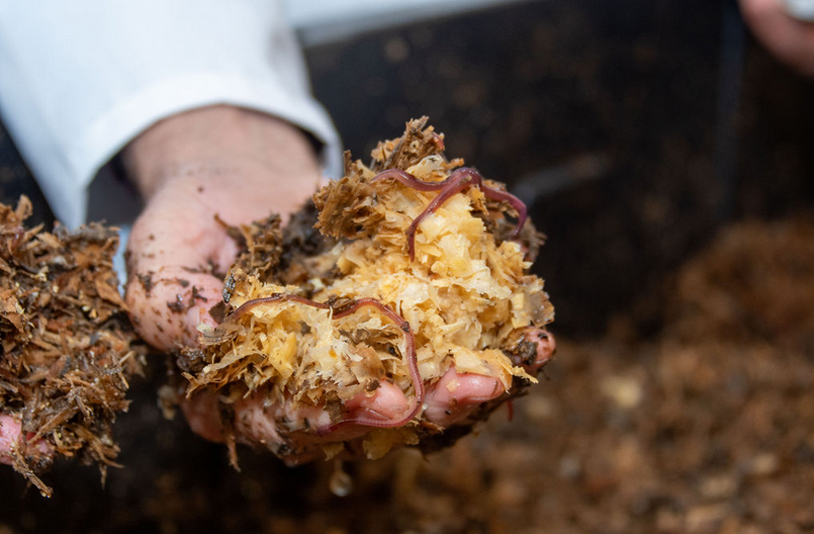
Vermiremediation involves using earthworms to treat various matrices (eg. soil, wastewater, etc.) by breaking down consuming, and/or transforming contaminants. This process can be employed in various ways. One approach integrates worms with other forms of bioremediation, such as bacteria or fungi, creating a synergistic effect that enhances the breakdown of pollutants. In this setup, worms work alongside microorganisms to degrade organic matter, heavy metals, and other harmful substances in the wastewater.
Another approach relies on worms as the primary treatment agents. In these systems, earthworms alone are responsible for consuming and breaking down contaminants. The worms’ digestive processes help convert complex pollutants into simpler, less harmful substances, effectively reducing the overall toxicity of the wastewater.
One of the most significant advantages of using worms in wastewater treatment is their ability to tackle a wide range of contaminants. Studies have shown that vermifiltration can significantly reduce pathogen levels in wastewater. Earthworms consume harmful bacteria, and the microbial community associated with vermifiltration helps to neutralize disease-causing pathogens, making the treated water safer for discharge or reuse.
Earthworms are remarkably efficient at breaking down organic matter, including phenols, polycyclic aromatic hydrocarbons (PAHs), and even pharmaceuticals. In addition to these contaminants, there is growing interest in how vermifiltration can address more challenging pollutants like PFAS (per- and polyfluoroalkyl substances). PFAS are persistent chemicals that are difficult to remove from wastewater with traditional methods. This versatility makes vermiremediation a potentially powerful tool for treating diverse types of wastewater, from agricultural runoff to industrial effluents.
One of the distinctive advantages of vermifiltration lies in its capability to recover valuable nutrients. The castings produced by earthworms are abundant in essential nutrients such as nitrogen and phosphorus. These nutrient-rich castings can be utilized as organic fertilizers, thereby creating a circular process in which waste is transformed into valuable by-products. This approach not only supports sustainable agricultural practices but also diminishes the dependence on synthetic fertilizers, contributing to environmental sustainability and resource efficiency.
Moreover, vermiremediation systems are relatively simple and inexpensive to maintain. Unlike conventional wastewater treatment methods that often require complex infrastructure and significant energy inputs, vermiremediation relies on natural processes that are self-sustaining and eco-friendly.
The system also has low maintenance requirements, as earthworms are self-sustaining and regenerate naturally. This makes it a sustainable, long-term solution, particularly in low-income or rural areas.
This simplicity translates into cost savings, particularly for small-scale or remote operations where traditional treatment systems may be impractical.
Beyond its technical advantages, vermiremediation has the potential to make a meaningful impact on broader environmental issues, such as nutrient pollution and hypoxic zones. One example is the hypoxic zone in the Gulf of Mexico, a vast area of low oxygen levels caused primarily by nutrient runoff from agricultural fields. These nutrients, particularly nitrogen and phosphorus, fuel the growth of algae, which, upon decomposing, deplete oxygen levels in the water, creating “dead zones” where aquatic life cannot survive.
Vermiremediation could help mitigate this problem by reducing the amount of nutrients that enter waterways. The worms used in the process can break down and consume chemicals and nutrients in the wastewater before it is discharged into the environment. A study by Liu et al. (2018) demonstrated the effectiveness of this approach, finding that vermifiltration systems were able to remove up to 97% of phenols, 85% of PAHs, and 77% of pharmaceuticals from wastewater. By filtering out these and other pollutants, vermiremediation can help prevent the nutrient overload that leads to hypoxic zones.
In Summary,
Vermifiltration emerges as a highly viable and environmentally sustainable method for natural wastewater treatment. Characterized by its cost-effectiveness, minimal maintenance needs, and capacity to handle substantial volumes of wastewater, this approach offers significant advantages over conventional treatment technologies. The process not only improves water quality by producing a high volume of treated effluent but also generates valuable byproducts, such as nutrient-rich worm castings, which can be utilized as organic fertilizers. These benefits underscore vermifiltration’s potential as a crucial component in addressing global water management challenges and advancing sustainable water treatment practices.